Quick Answer
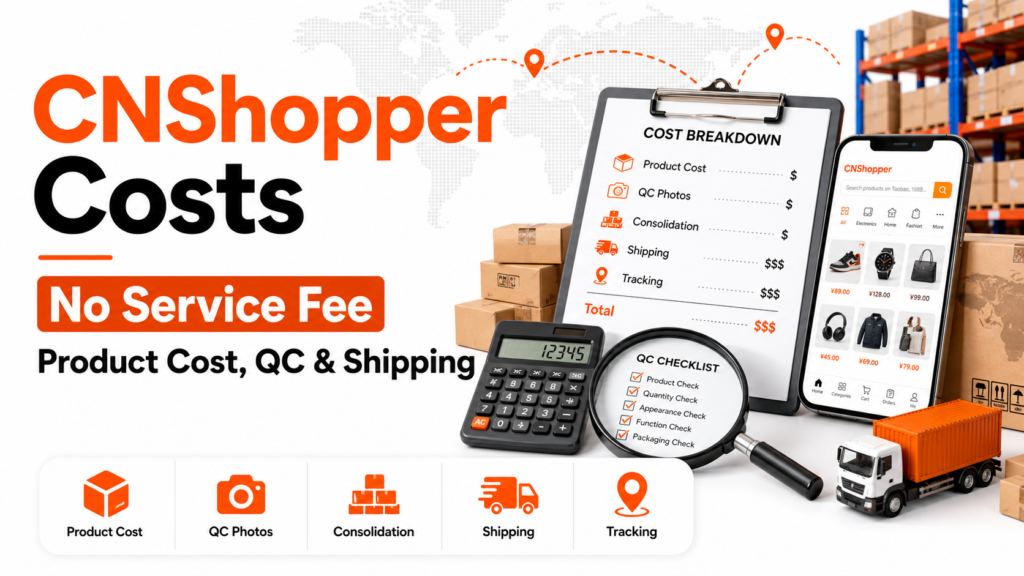
If you are researching Customs Duty from China to USA: Rates & Guide, the safest approach is to check duty rules, tax thresholds, product classification, declared value, shipping method and documentation before importing. This guide explains what to check before paying and how a China shopping agent can reduce ordering, QC, consolidation and shipping mistakes.
| Area | What to check | Why it matters |
|---|---|---|
| Product | Size, color, quantity, photos, variants and stock. | Most mistakes start before payment. |
| Seller | Reputation, communication, price and terms. | Helps avoid delays and wrong products. |
| Total cost | Product price, domestic shipping, service fee, international shipping and customs. | The final price can be very different from the item price. |
| Shipping | Route, delivery time, tracking, restrictions and volumetric weight. | Affects cost, reliability and customs risk. |
Key Questions Before You Buy
What is the safest way to move forward?
The best approach is to compare product details, seller reliability, total landed cost, shipping route and customs risk before paying. For Chinese marketplaces, an agent can help with purchase, QC photos, consolidation and international shipping.
Do I need a China shopping agent?
An agent is useful when the platform does not support international payment, the seller only ships inside China, you need product checks, or you want to combine multiple parcels into one shipment.
How can I reduce cost and risk?
Start with smaller orders, confirm product details, review QC photos, compare shipping routes and check customs or restricted-product rules before international delivery.
Related CNShopper guides: How to buy from China · international shipping from China · China shopping agent comparison · China shopping agent fees · Taobao vs 1688 vs Tmall.
Customs Duty from China to USA: 2026 Rates & Guide
Last updated: June 5, 2026
Quick Answer: What Will You Pay?
Most shipments from China valued under $800 USD qualify for Section 321 de minimis entry and pay $0 in duty. For shipments over $800, you will typically pay ad valorem (percentage-based) duties ranging from 0% to 37.5% depending on the product classification plus any applicable Section 301 tariffs on Chinese-origin goods. The actual rate is determined by the product’s Harmonized Tariff Schedule (HTS) code and its country of origin.
This guide explains every element of US customs duties on Chinese imports so you can accurately estimate your landed cost before placing an order.
Section 321 De Minimis Threshold ($800)
The most important number for anyone importing from China to the United States is $800. Under Section 321 of the Tariff Act of 1930, shipments valued at $800 or less can enter the US duty-free with minimal customs formalities. This is commonly called the de minimis threshold.
Key facts about Section 321:
- Raised from $200 to $800 in 2016 under the Trade Facilitation and Trade Enforcement Act
- Applies to one shipment per person per day
- Covers most commercial shipments and personal imports
- Does not apply to alcohol, tobacco, perfume containing alcohol, or certain textiles subject to quota
- The $800 valuation uses the transaction value (what you actually paid for the goods, not the retail price)
As of 2026, there have been discussions at CBP and on Capitol Hill about potential reform of the de minimis rule, particularly for goods from China. Any changes would require an act of Congress. For now, the $800 threshold remains the single biggest duty-saving tool for small shipments.
HTSUS: How Products Are Classified
Every imported product has a 10-digit Harmonized Tariff Schedule (HTS) code maintained by the US International Trade Commission (USITC). This code determines the base duty rate applied to your goods. The first six digits are the international Harmonized System (HS) standard; the last four are US-specific.
How HTS codes work:
- Chapter (first 2 digits) – broad category, e.g., Chapter 84 for machinery, Chapter 61 for knit apparel
- Heading (first 4 digits) – specific product family
- Subheading (first 6 digits) – more specific product type
- US statistical suffix (last 4 digits) – US-only detail for trade data
For example, an electronic accessory from China might fall under HTS 8473.30.5100. The base duty rate for that code might be free or a few percent, but Section 301 tariffs could add an extra 7.5% to 25%.
You can look up any HTS code and its base rate for free at hts.usitc.gov. CBP also publishes binding rulings and guidance for correct classification.
Section 301 Tariffs on Chinese Goods
Beginning in 2018 and continuing into 2026, the United States has imposed additional tariffs on Chinese-origin goods under Section 301 of the Trade Act of 1974. These tariffs apply in addition to the base HTS duty rate.
The current Section 301 tariff structure (as of 2026):
- List 1 & 2 (2018) – $50 billion of goods at 25%
- List 3 (2019) – $200 billion of goods initially at 10%, later raised to 25%
- List 4A (2019) – $120 billion of goods at 7.5%
- List 4B (2019) – originally scheduled but suspended
These lists cover thousands of product categories from electronics components and machinery to apparel, furniture, tools, and consumer goods. Specific exclusions have been granted periodically by the Office of the US Trade Representative (USTR), but most exclusions have expired.
To find out if your product is subject to Section 301 tariffs, check the USTR Section 301 page or consult the HTS code with its special tariff program indicators.
Step-by-Step Duty Calculation Example
Let’s walk through a real-world example to show how it all fits together.
Scenario: Importing LED Desk Lamps from China
Step 1: Determine the value of the goods
Invoice value: $2,000 (100 lamps at $20 each)
Shipping & insurance (CIF): $300
Total value for duty (transaction value): $2,300
Step 2: Find the HTS code
Using hts.usitc.gov, LED lamps fall under HTS 9405.29.8010 (electric lighting fittings). The base duty rate is free (0%).
Step 3: Check for Section 301 duties
Chinese-origin lighting products are on Section 301 List 3, subject to 25% additional tariff.
Step 4: Calculate total duty
Base duty: $2,300 × 0% = $0
Section 301 tariff: $2,300 × 25% = $575
Total duty & tariffs: $575
Step 5: Calculate total landed cost
Product cost: $2,000
Shipping: $300
Duty: $575
Customs broker fee (typical): $50–$150
CBP Merchandise Processing Fee (MPF): 0.3464% of value (max $605.79 per entry)
Harbor Maintenance Fee (HMF, if ocean freight): 0.125% of value
Estimated landed cost: $2,925–$3,025
This example illustrates why ignoring Section 301 tariffs can lead to a surprise cost increase of 25% or more. Always calculate duty before placing a purchase order from a Chinese supplier.
Additional Fees & Taxes
Beyond the duty and tariff rates themselves, importers should expect the following fees:
- Merchandise Processing Fee (MPF) – 0.3464% of the value, capped at $605.79 for automated entries and $32.71 for manual entries. Set by CBP.
- Harbor Maintenance Fee (HMF) – 0.125% of cargo value for shipments arriving by vessel, collected by CBP.
- Customs Broker Fee – A service fee charged by a licensed customs broker who handles your entry documentation. Typical range: $50–$150 for a simple entry.
- Duty applies only to the total entered value, not to US domestic freight costs.
Note that the US does not charge VAT or GST on imports, unlike many other countries. This keeps the landed cost lower than importing into the EU or UK for example.
US Customs Clearance Process Overview
Importing goods from China to the United States involves several steps. Here is a simplified overview of the customs clearance process:
1. Documents Preparation
Your shipment needs the commercial invoice, packing list, bill of lading (ocean) or air waybill (air), and any certificates of origin or permits required for regulated goods.
2. Entry Filing
Either you or your customs broker files the entry summary with CBP’s Automated Commercial Environment (ACE). This includes the HTS code, value, country of origin, and duty calculation.
3. Bond Requirement
For formal entries (value over $2,500 or certain regulated goods), you must post a customs bond. A single-entry bond costs about 3% of the shipment value; a continuous annual bond costs $500–$1,500+.
4. Examination & Release
CBP may examine the shipment (documentary or physical inspection). Most shipments are “paper released” without physical inspection. Once cleared, CBP issues a release notice.
5. Duty Payment
Duties and fees are paid at the time of entry. Most commercial importers pay through their broker or via ACE periodic monthly statements.
For shipments valued under $2,500, you can use informal entry, which has simpler paperwork and no bond requirement. And as noted above, shipments under $800 can enter duty-free under Section 321. More details are available on the CBP import basics page.
Duty Exemptions & Special Programs
Several programs may reduce or eliminate customs duties on Chinese imports:
- Section 321 De Minimis – Up to $800 per person per day, duty-free entry. The most commonly used exemption for small packages.
- Generalized System of Preferences (GSP) – Duty-free entry for certain products from developing countries. However, China is not currently a GSP beneficiary, so this does not apply.
- Duty Drawback – If you import goods from China and later export them from the US, you can recover up to 99% of the duties paid. Apply through CBP.
- Foreign Trade Zones (FTZs) – Goods can enter an FTZ duty-free for storage, assembly, or processing. Duty is paid only when goods leave the zone for US consumption.
- Section 301 Exclusion Requests – USTR periodically opens windows for specific products to be excluded from Section 301 tariffs. Check the USTR exclusions page for current opportunities.
Frequently Asked Questions
How much customs duty will I pay on a $500 shipment from China?
Zero if the shipment qualifies under Section 321 de minimis. Shipments valued at $800 or less enter the US duty-free provided they are not restricted goods. This is one of the most valuable rules for small-volume importers and individual buyers on platforms like AliExpress, Temu, or Taobao.
How do I find the duty rate for my specific product from China?
Look up the 10-digit HTS code at hts.usitc.gov to get the base rate, then check the USTR Section 301 tariff list to see if your product carries an additional duty. Many products from China face an extra 7.5% to 25% on top of the base rate.
Is Section 321 de minimis still valid in 2026 for goods from China?
Yes. The $800 threshold under Section 321 remains in effect as of June 2026. While there have been policy discussions about reforming de minimis treatment for Chinese e-commerce goods, no legislation has been enacted. Always check CBP announcements for the latest updates.
What is the difference between tariff and duty?
In everyday use the terms are interchangeable. Technically, a tariff is a tax imposed as a trade policy measure (like Section 301 tariffs on Chinese goods), while duty broadly refers to all taxes collected on imports under the HTS. Both are paid to CBP at the time of entry.
Do I need a customs broker to import from China to the US?
For informal entries (value under $2,500) you can clear goods yourself using the CBP simplified process. For formal entries over $2,500, most importers use a licensed customs broker. CBP maintains a broker search tool to find one.
Get a Real-Time Customs Estimate
Estimating customs duties on goods from China doesn’t have to be guesswork. Whether you are importing electronics, apparel, auto parts, or consumer goods, knowing your total landed cost before you commit to a purchase is essential for protecting your margins.
Use our product search tool to check current prices, availability, and specifications across verified Chinese suppliers. Then take those product details to calculate your estimated duty using the HTS-guided approach described above. Start your search here:
Need more help with sourcing from China? Browse our main site for supplier information and tips. You might also find our guide on buying from China for beginners helpful for getting started with Chinese suppliers.
Disclaimer: This article provides general guidance only and does not constitute legal or customs advice. Duty rates, trade policies, and regulations are subject to change. Always consult a licensed customs broker or trade attorney for advice specific to your shipment. For the most current official information, refer to CBP at cbp.gov and USITC at usitc.gov.