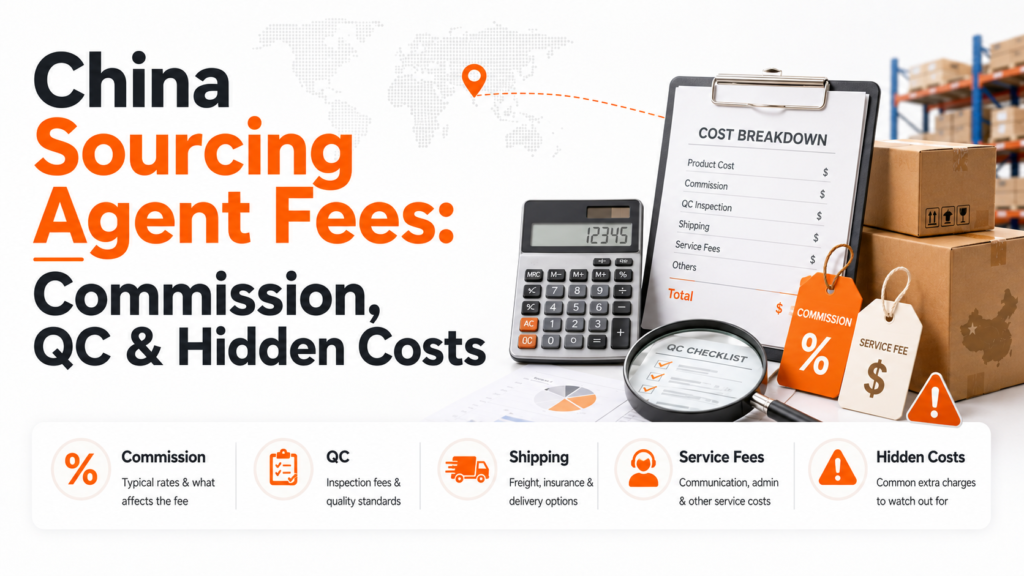
China sourcing agent fees can look simple on the surface, but the real cost depends on commission, supplier search work, samples, inspection, payment handling, domestic logistics, consolidation, international shipping and after-sales support. A low commission is not automatically a good deal if the quote hides costs in shipping, exchange rates or weak quality control.
This guide is written for buyers who are comparing sourcing agents for wholesale, private-label, sample-based or repeat orders from China. It explains what each fee usually covers, what questions to ask and how to compare the final landed cost instead of chasing the lowest headline percentage.
Quick Answer
A sourcing agent fee is worth paying when the agent reduces supplier risk, prevents quality mistakes, improves communication, finds better quotes or saves you from shipping unusable goods. It is not worth paying when the agent only forwards seller screenshots, cannot explain the quote or gives no clear process for samples, inspection or disputes.
Common China Sourcing Agent Fee Models
Most agents use one or more pricing models. Ask which model applies before you send money.
| Fee model | How it works | Best for | Risk |
|---|---|---|---|
| Commission | Agent charges a percentage of order value | Managed orders and repeat purchasing | Unclear base: product value or full invoice? |
| Fixed sourcing fee | One-time fee for supplier search and quote comparison | Finding suppliers before order commitment | May not include order follow-up |
| Project fee | Set fee for sourcing, samples, negotiation and coordination | Custom or private-label products | Scope can be vague |
| Service item pricing | Separate fees for photos, QC, storage, repacking or labels | Buyers who need specific services | Total cost can grow quickly |
| Shipping margin | Margin is built into logistics quote | Agents who manage delivery | Hard to compare without weight and route details |
Cost Breakdown Table
A professional quote should separate costs clearly. If the agent cannot break down the total, you cannot compare them fairly.
| Cost item | What it covers | Question to ask |
|---|---|---|
| Supplier search | Finding factories or sellers that match your specification | How many suppliers will be compared? |
| Sample handling | Buying, receiving and checking samples | Are sample photos and measurements included? |
| Commission | Agent margin for managing the order | Is it based on product cost or total cost? |
| QC or inspection | Checking product condition before shipment | Is it a basic photo check or formal inspection? |
| Domestic freight | Seller to warehouse shipping inside China | Is it included in the product quote? |
| Warehouse services | Storage, labeling, repacking, consolidation | How many free storage days are included? |
| International shipping | Courier, air, sea, rail or dedicated line | What weight, dimensions and route is the quote based on? |
| After-sales support | Returns, refunds, disputes and replacement handling | What happens if goods fail inspection? |
Hidden Costs Buyers Often Miss
The most common hidden costs are not mysterious. They usually appear because the buyer compared only product price or commission. Watch for exchange-rate spreads, domestic freight, sample reshipping, repacking fees, storage fees, remote-area shipping charges, dimensional weight, insurance gaps, customs brokerage and unclear return costs.
Supplier rebates are another issue. Some agents may receive a benefit from suppliers. That does not automatically mean the agent is bad, but it does mean you should ask how suppliers were selected and whether you can see comparable quotes.
Quote Checklist Before You Choose an Agent
- Send the same product specification to each agent.
- Ask for line-item costs, not only a total.
- Confirm whether commission applies to product cost or full invoice value.
- Ask what proof you receive from supplier search, sample checks and QC.
- Confirm storage time, repacking policy and consolidation fees.
- Ask what happens if a sample fails or bulk goods fail inspection.
- Compare the landed cost to your target selling price or budget.
A useful sourcing quote should help you make a decision. If it only gives a low percentage, it is not enough.
When the Fee Is Worth It
A sourcing agent is usually worth it when product risk, supplier risk or order value is high. Examples include private-label products, repeated wholesale orders, custom packaging, size-sensitive goods, electronics, products with compliance requirements or orders where a failed shipment would cost more than the fee.
If you only need to buy existing Taobao or 1688 links, you may not need a full sourcing project. A buying agent or shopping agent can be enough. Compare those lighter workflows in the best China buying agent guide, 1688 agent guide and China shopping agent comparison.
How to Think About CNShopper
CNShopper is most useful when you need help ordering from Chinese platforms, checking warehouse information, consolidating goods and arranging international delivery. For complex supplier discovery or production projects, use this fee guide to understand which services you need before comparing any sourcing offer. You can start from cnshopper.com.
FAQ
What is a fair China sourcing agent fee?
It depends on scope. A simple repeat order should cost less than a project involving supplier search, samples, negotiation, inspection and production follow-up.
Should I choose the lowest commission?
Not automatically. A low commission can be offset by poor QC, weak supplier selection, expensive shipping or unclear after-sales support.
What should be included in a sourcing quote?
At minimum: product cost, agent fee, sample cost, domestic freight, QC or inspection, warehouse charges, international shipping assumptions and after-sales terms.
Cost-control note: Always separate commission, QC inspection, service fee, sample cost and shipping in your landed cost sheet so hidden costs are visible before production starts.